Writing / Technical / LLMs & GenAI
Recursive Reward Modeling Explained: A Simple Tutorial with Real Examples 🧩
A simple, practical tutorial on Recursive Reward Modeling, showing how scalable oversight can help train more capable AI systems without overwhelming human evaluators.
What if we could train super-powerful AIs while always keeping humans in the loop - even when the tasks get too complex for us to judge directly?
That’s exactly what Recursive Reward Modeling (RRM) tries to do. It’s one of the most promising ideas in AI alignment and scalable oversight.
Don’t worry - I’ll explain everything in plain English, like you’re learning it for the first time. No heavy math required. We’ll go step by step and end with a concrete, real-world-style example.
First: What Is Regular Reward Modeling?
Before we get to the “recursive” part, let’s start with the basics.
In normal AI training (like ChatGPT or Claude), we use Reinforcement Learning from Human Feedback (RLHF):
- Humans look at two AI answers and say “I prefer Answer A over Answer B.” If you use chatGPT you would have surely come accross it.
- We train a Reward Model - basically an AI judge that learns to predict what humans would prefer.
- We use that reward model to train the main AI to produce better outputs.
This works great for simple tasks (writing short emails, answering basic questions). But what happens when the task gets really complex?
- Writing a 10,000-line software program
- Designing a new computer chip
- Planning a long-term business strategy
A human can’t easily read the whole thing and say “this is good” or “this is bad.” It would take too much time or expertise. That’s where Recursive Reward Modeling comes in.
What Makes It “Recursive”?
“Recursive” just means repeating the same helpful trick at higher and higher levels.
Instead of asking humans to judge super-complex outputs directly, we train helper AIs to assist the humans in the judging process.
Then we use those improved judgments to train even stronger main AIs… which in turn can help train even better helper AIs… and so on.
It’s like building a company:
- The CEO (human) can’t check every employee’s work.
- So you hire managers (helper AIs) to summarize, check, and flag problems.
- The managers themselves were trained with human feedback, so they stay aligned.
This creates a virtuous cycle that scales with the AI’s intelligence.
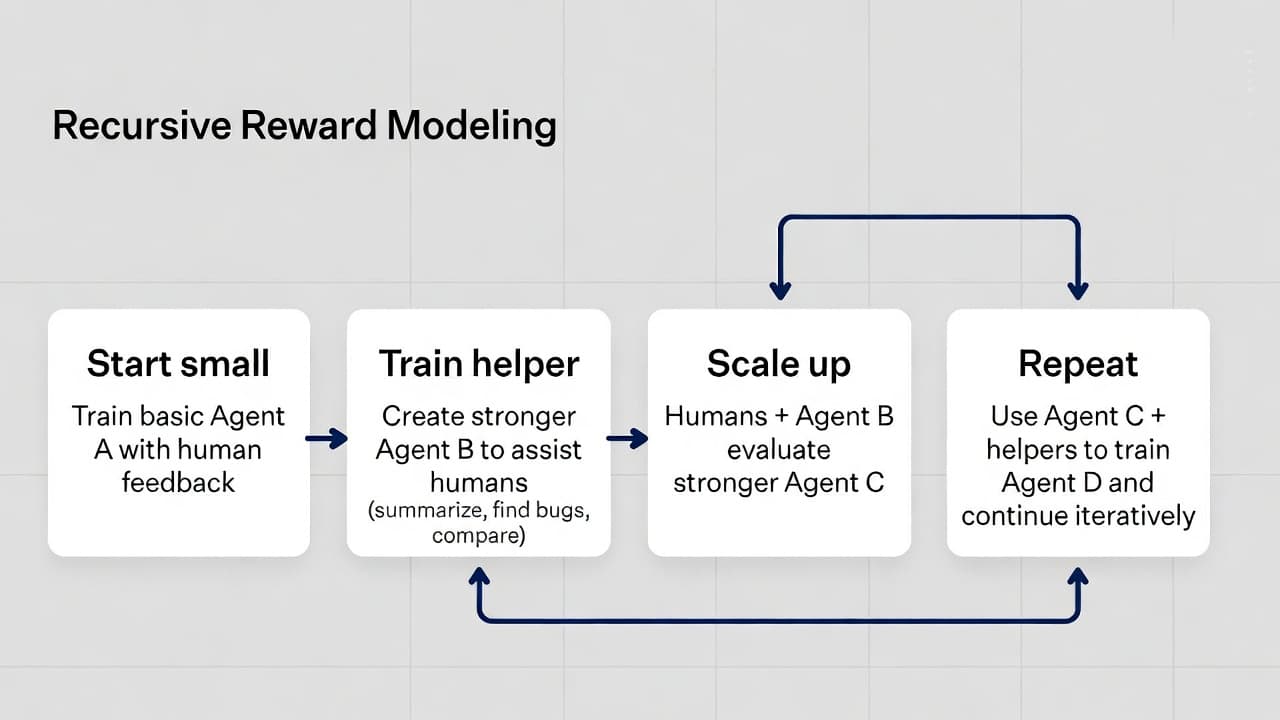
Here is Step by Step Guide On How Recursive Reward Modeling Works
Here’s the simple loop:
-
Start small
Train a basic AI (let’s call it Agent A) using normal human feedback and reward modeling. -
Train a helper
Train a second AI (Agent B slightly stronger) to help humans evaluate Agent A’s work.
Example: Agent B can summarize long code, find obvious bugs, or compare two solutions side-by-side. -
Use the helper to train the next level
Now humans + Agent B together evaluate the work of a new, even stronger AI (Agent C).
Because Agent B does the heavy lifting (summarizing, checking details), humans can give high-quality feedback on much harder tasks. -
Repeat
Use Agent C + new helpers to train Agent D… and keep going.
Each level of helper AI makes the human’s job easier, so we can keep scaling to more powerful models while staying aligned with what humans actually want.
Real Example: Training an AI to Write Complex Code
Let’s make this concrete with a practical example most developers will recognize.
Goal: Train an AI that can write and debug a full mobile app (thousands of lines of code).
Without RRM: A human would have to read the entire app and say “this is good.” Impossible in reasonable time.
With Recursive Reward Modeling:
-
Level 1
Train Agent A (basic coder) on small functions using direct human feedback. -
Level 2
Train Agent B (reviewer) to help humans evaluate bigger code.- Agent B can: summarize each file, list potential bugs, compare two versions of the same feature.
- Human now only needs to look at Agent B’s summary + flags instead of 2,000 lines of code.
-
Level 3
Train Agent C (advanced coder) using feedback from humans + Agent B.
Now humans can judge full app features because Agent B breaks everything down. -
Level 4 and beyond
Train even stronger reviewer agents that help evaluate entire apps or systems.
The process repeats - each new coder gets better helpers.
Result? You end up with a super-capable coding AI, but every step was guided by human preferences (just amplified through helpers).
Here’s a tiny pseudocode version of the idea:
# Level 1: Basic coder
agent_A = train_coder_with_human_feedback()

# Level 2: Helper reviewer
agent_B = train_reviewer_to_assist_humans(agent_A)

# Level 3: Stronger coder
agent_C = train_coder_with_help_of_reviewer(agent_B)

# Repeat...
agent_D = train_coder_with_help_of_reviewer(train_new_reviewer(agent_C)) Keep the article same for now. Just change the mdx top parameters to match our website also suggest the type. Do we have callbacks if not lets add them
If this made you think, feel free to leave a ❤️